O-Rings: An Essential Guide
O-rings are versatile and widely used sealing devices, critical in many industries for preventing fluid and gas leakage. Their simple design belies their effectiveness, making them a cornerstone of modern engineering.
What is an O-Ring?
An O-ring is a toroidal, or doughnut-shaped, mechanical gasket. It is designed to be seated in a groove and compressed during assembly between two or more parts, creating a seal at the interface. The material of the O-ring, often an elastomer, allows it to deform and fill minute imperfections, thereby blocking the passage of fluids or gases.
Key Considerations for O-Ring Selection
When selecting an O-ring, several factors must be taken into account:
● Fluid Compatibility: The O-ring material must be compatible with the fluid or gas it will be sealing to prevent degradation.
● Temperature Range: The O-ring must maintain its sealing properties across the full operating temperature range.
● Pressure: The O-ring and groove design must be able to withstand the system pressure without extrusion.
● Application Type: Static or dynamic applications will influence material and design choices.
● Size (ID, OD, CS) Inner Diameter (ID), Outer Diameter (OD), and Cross-Section (CS) are critical for proper fit.
Installation and Maintenance
Proper installation is vital for O-ring performance. This includes ensuring the O-ring is free from damage, correctly sized for the groove, and adequately lubricated (if required). Regular inspection and replacement as part of a maintenance schedule can prevent unexpected failures. Common O-Ring Failure Modes Understanding common failure modes can help in troubleshooting and preventing future issues:
● Extrusion: The O-ring material is forced into the clearance gap under pressure.
● Compression Set: The O-ring fails to return to its original shape after compression, leading to loss of sealing force.
● Chemical Degradation: The O-ring material reacts with the sealed fluid, leading to hardening, softening, or cracking.
● Abrasion: Wear due to friction in dynamic applications.
How Do O-Rings Work?
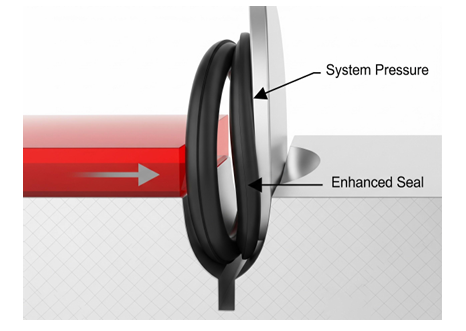
The sealing action of an O-ring relies on controlled deformation. When installed, the O-ring is slightly compressed, forcing its material to fill the gaps between the mating surfaces. This initial compression provides the primary sealing force. When pressure is applied to the system, this pressure acts on the O-ring, further deforming it and enhancing the sealing force against the mating surfaces. This phenomenon is known as "pressure-assisted sealing."
Materials for O-Rings
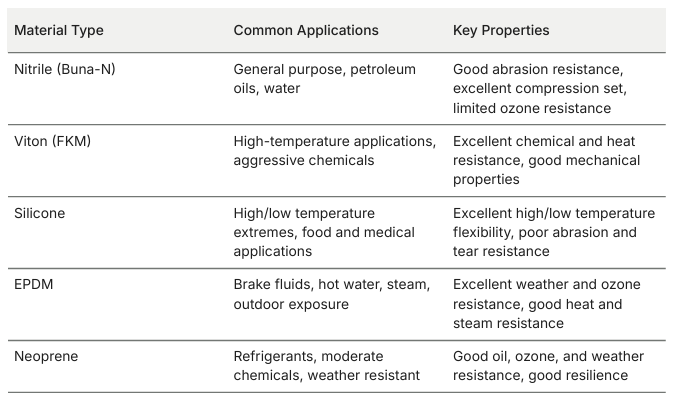
The choice of O-ring material is crucial for its performance and longevity, depending on the operating environment, temperature, chemical compatibility, and pressure. Common materials include: